
If you've ever prepared paperwork for a client, you've probably come across terms like estimate, proposal, contract, and invoice. While these documents often appear together during a project, they are not interchangeable. Each serves a specific purpose, and using the wrong one at the wrong time can create confusion, delays, or even payment disputes.
For freelancers, consultants, agencies, and small businesses, understanding the role of each document helps create a smoother client experience from the very first conversation to the final payment.
In this guide, we'll explain what each document does, when you should use it, and how they work together throughout a project.
Understanding the Client Journey
Before looking at each document individually, it helps to understand the typical client journey.
A potential client contacts your business looking for a product or service.
You discuss their needs and provide pricing information.
If they decide to move forward, both parties agree on the scope of work and payment terms.
The work is completed.
Finally, you request payment.
Each step is supported by a different document. Using the right one at the right time keeps expectations clear and helps avoid misunderstandings.
What Is an Estimate?
An estimate is an educated approximation of what a project is likely to cost.
At the beginning of a project, you may not yet know every detail. The client might still be deciding on features, quantities, materials, or timelines. Because of these uncertainties, an estimate gives the client a general idea of the expected cost without committing either party to an exact price.
For example, a web designer might estimate that a website redesign will cost between $2,500 and $3,000 depending on the final requirements.
An estimate helps clients decide whether a project fits within their budget while giving businesses flexibility if the scope changes.
Estimates are most useful during the early planning stages when many project details are still being discussed.
What Is a Proposal?
Proposals focus on convincing the client that you're the right choice for the project.
Instead of simply listing prices, a proposal explains the client's problem, outlines your recommended solution, describes your approach, highlights your experience, provides a timeline, and often includes pricing.
Think of a proposal as both a sales document and a project plan.
For example, a marketing consultant responding to a company's request for help wouldn't simply send a price. They would explain how they intend to improve the company's marketing, what activities they'll perform, how success will be measured, and what investment is required.
Proposals are commonly used for larger projects, consulting work, creative services, and business-to-business engagements where clients evaluate multiple providers before making a decision.
What Is a Contract?
A contract is the legal agreement between you and your client.
Once the client accepts your proposal, both parties should clearly document the terms of the project before work begins.
A contract typically includes:
The scope of work.
Project timelines.
Payment terms.
Responsibilities of both parties.
Revision limits.
Cancellation terms.
Ownership of intellectual property.
Confidentiality clauses.
Late payment policies.
Unlike estimates or proposals, a contract is designed to protect both parties if disagreements arise.
While every project doesn't require a lengthy legal document, having written agreements is one of the simplest ways to reduce misunderstandings later.
What Is an Invoice?
An invoice is the document that requests payment after products or services have been delivered.
Unlike every previous document, an invoice is not used to discuss pricing or negotiate the project. The work has already been agreed upon and completed.
A professional invoice typically includes:
Your business information.
Your client's information.
Invoice number.
Invoice date.
Payment due date.
Description of the completed work.
Taxes, if applicable.
The total amount due.
Payment instructions.
Invoices also become part of your accounting records, making them important for bookkeeping, tax reporting, and financial management.
How These Documents Work Together?
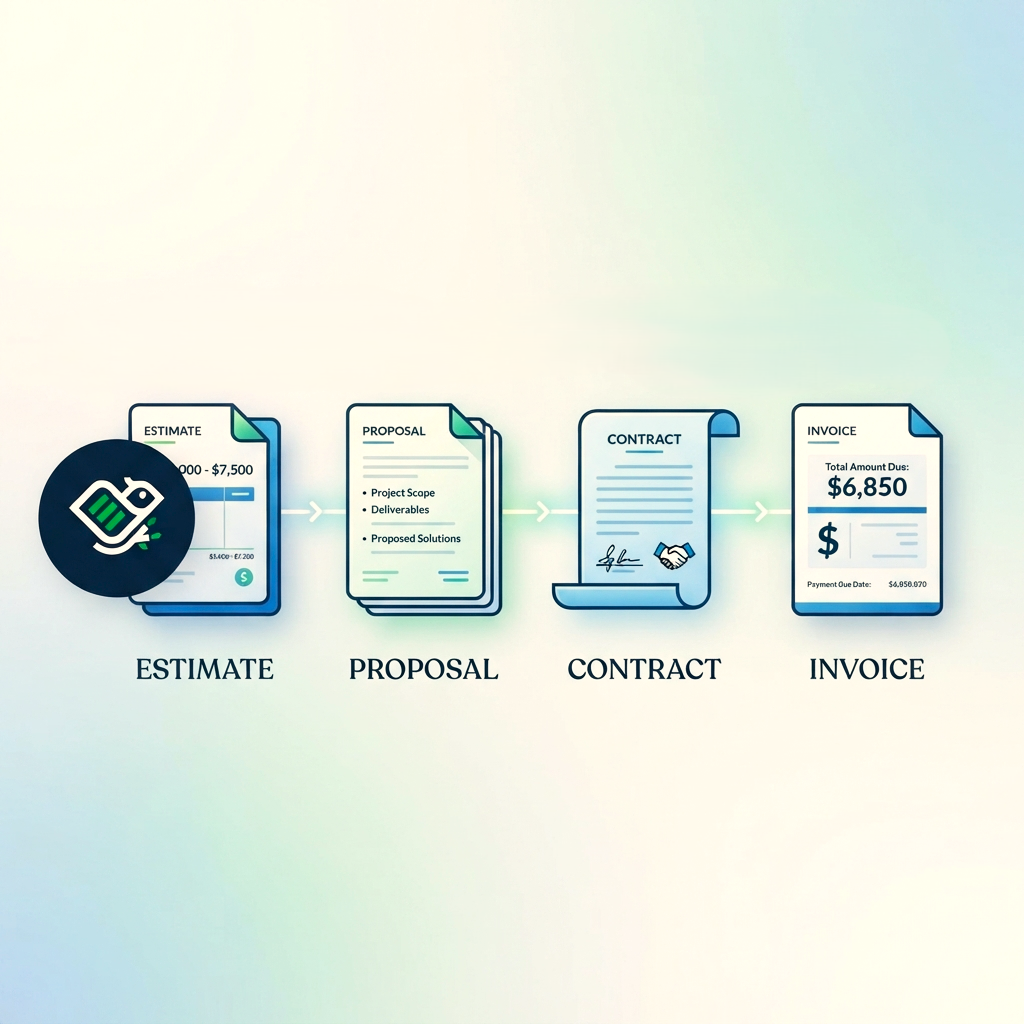
Although each document serves a different purpose, they often form a natural workflow.
The process usually begins with an estimate if the project scope is still uncertain.
Once the client's requirements become clear, a detailed proposal is prepared.
If the client accepts, both parties sign a contract outlining the agreed terms.
The work is completed according to the agreement.
Finally, an invoice is issued requesting payment.
Following this sequence keeps the project organized and ensures everyone understands what has been agreed upon at every stage.
Common Mistakes Businesses Make
One of the most common mistakes is sending an invoice before the scope of work has been fully agreed. Without a proposal or contract, clients may question the price or dispute what was delivered.
Another common mistake is treating an estimate like a fixed price. If the project changes significantly, the original estimate may no longer reflect the actual work required.
Some businesses also rely entirely on verbal agreements. While trust is important, documenting expectations in writing protects both you and your client if questions arise later.
Finally, many businesses use generic templates that don't clearly explain the purpose of each document. Clients appreciate paperwork that is easy to understand and professionally presented.
Which Documents Does Every Small Business Need?
Not every project requires all four documents.
For small, straightforward jobs, an estimate followed by an invoice may be enough.
Larger projects usually benefit from a proposal and a signed contract before any work begins.
Businesses working with ongoing clients may also use recurring invoices once the relationship has been established.
The important thing is choosing the documents that match the complexity of your work while maintaining clear communication throughout the client relationship.
Why Professional Documentation Matters
Professional documents do more than organize paperwork.
They build confidence.
When clients receive clear estimates, detailed proposals, transparent contracts, and accurate invoices, they see a business that values organization and professionalism.
Good documentation also reduces misunderstandings, speeds up approvals, supports accurate bookkeeping, and helps businesses get paid more efficiently.
Instead of relying on disconnected files, spreadsheets, or manually created documents, many businesses use invoicing software that keeps estimates, proposals, invoices, and client information organized in one place. This not only saves time but also creates a more consistent experience for both the business and its customers.
Frequently Asked Questions
How should I handle a client who requests changes to the scope after the contract is already signed?
You should always issue a formal change order document that outlines the new requirements, updated pricing, and timeline adjustments to ensure both parties remain protected.
What is the best way to explain these document differences to a client who is confused by the terminology?
Frame the documents as a series of project milestones that help manage their expectations and ensure a high-quality delivery throughout the entire engagement.
What features should I prioritize when selecting software to manage these different document types?
Prioritize platforms that offer seamless integration between your proposals and invoices to ensure that your project pricing remains consistent across every stage of the workflow.
Put this into practice
Create your next invoice with the free InvoiceBirds generator, professional templates, automatic totals, instant PDF. No account needed.
Try the free invoice generator