
Technology was supposed to make business easier.
For many small businesses, it sometimes does the opposite.
A company might start with one simple tool.
Then it adds another.
Then another.
Soon, employees are logging into six, eight, or even more platforms every day.
The problem is not having too much technology.
The problem is having technology that creates more complexity than value.
How businesses end up with too many tools
Most software purchases happen for understandable reasons.
A company needs a CRM.
Then it needs email marketing.
Then project management.
Then accounting.
Then analytics.
Then customer support.
Then another tool appears that promises to solve a specific problem.
Individually, each tool may be useful.
The problem appears when they start overlapping.
Two platforms may store customer information.
Three systems may contain sales data.
Employees may need to copy information from one application into another.
Now technology is creating administrative work.
The hidden cost of software
The price of software is not only the monthly subscription.
There are other costs:
Training
Setup
Maintenance
Data migration
Integration
Employee confusion
Duplicate information
Switching between applications
A $20 tool does not necessarily cost $20.
If employees spend several hours every month working around it, the real cost is much higher.
More data does not always mean better information
Another issue is fragmented data.
Imagine a company has customer information in its CRM, payment information in another system, project information somewhere else, and communication history in email.
The information exists.
But getting a complete picture requires combining it manually.
That makes decision-making slower.
A business owner may know how much revenue the company generated but struggle to answer:
Which customers are most profitable?
Which ones are late?
Which services generate the most repeat business?
Where are customers dropping out?
The problem is not lack of data.
It is lack of connected information.
Look for a single source of truth
A "single source of truth" means having one trusted place for a particular type of information.
That does not necessarily mean one application for everything.
It means everyone knows where the official information lives.
For example:
Customer information belongs in the CRM.
Financial records belong in the financial system.
Project status belongs in the project-management system.
The goal is clarity.
Audit your technology stack
Once or twice a year, businesses should review the software they use.
Create a simple list:
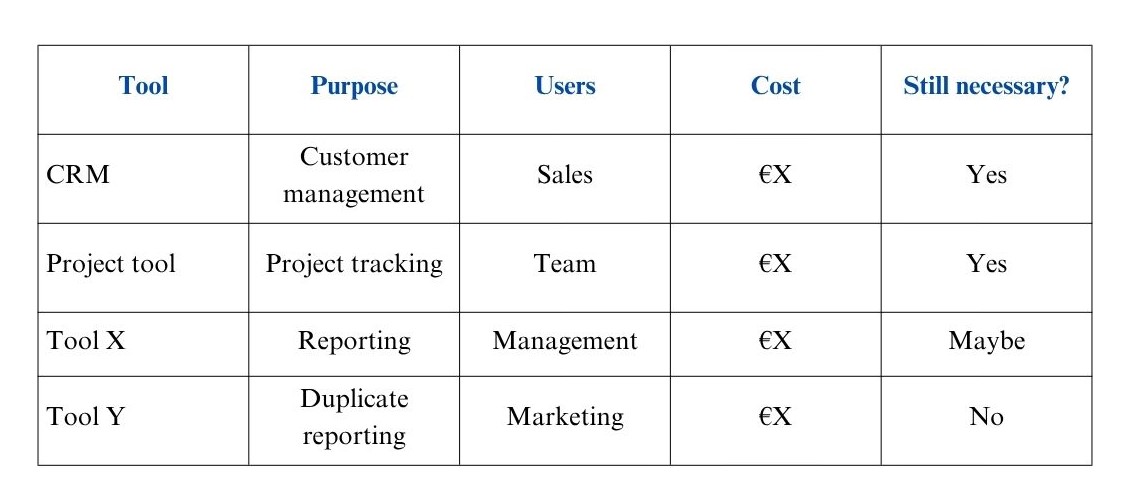
This exercise often reveals surprising duplication.
A company may discover that it is paying for two tools that perform almost the same function.
Integration matters
If multiple tools are necessary, integration becomes important.
A good technology stack should minimize manual data movement.
When information enters one system, it should ideally flow into the next system automatically when appropriate.
For example, a new customer could trigger:
Customer record creation
Internal notification
Welcome email
Project creation
Follow-up task
The exact workflow depends on the business, but the principle is the same.
Information should move with the process instead of requiring someone to move it manually.
The best technology stack is not the biggest one
Small businesses sometimes feel pressure to look technologically advanced.
But having ten applications does not make a business more sophisticated than having five.
The better question is:
Does each tool make the business easier to run?
If not, it may be time to simplify.
Technology should reduce friction.
It should not become another thing the team has to manage.
FAQ
How many software tools should a small business use?
There is no ideal number. The right stack depends on the company's needs, team size, and processes.
Should everything be integrated?
Not necessarily. Integration is most valuable when information needs to move regularly between systems.
How often should businesses review their software?
A technology audit once or twice a year can help identify unnecessary subscriptions, duplication, and outdated processes.
What is a single source of truth?
It is a trusted system or location where the official version of particular business information is maintained.
Put this into practice
Create your next invoice with the free InvoiceBirds generator, professional templates, automatic totals, instant PDF. No account needed.
Try the free invoice generator