
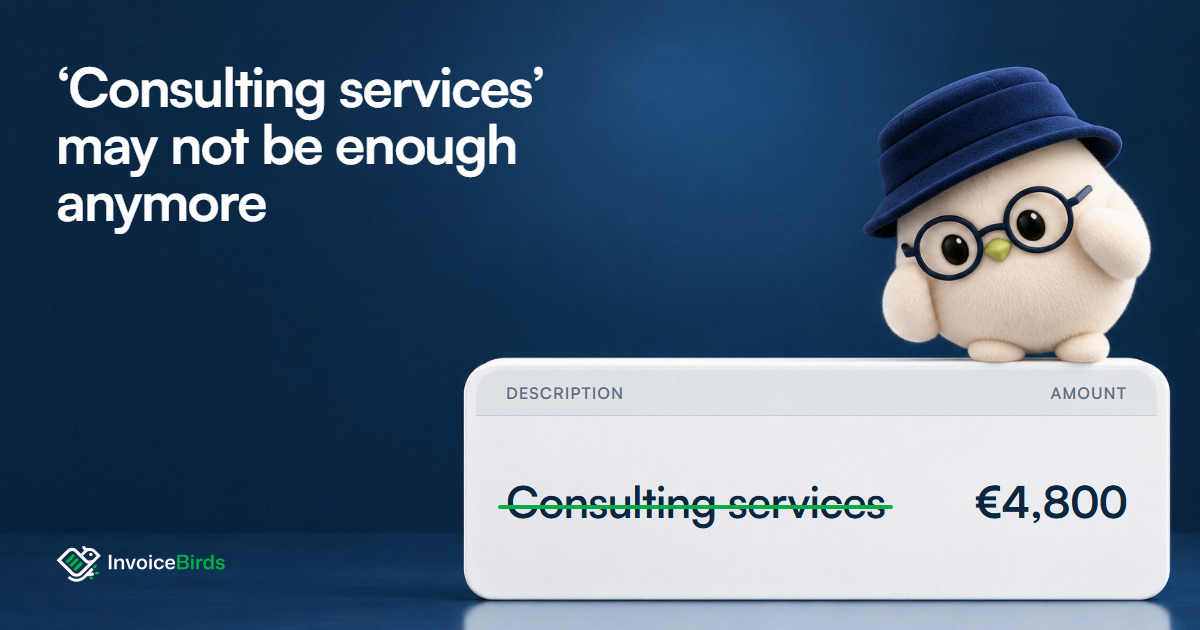
Short answer: The German Finance Ministry's letter of 15 October 2026 doesn't move the dates. If your 2026 turnover is above €800,000, you must issue e-invoices to German business clients from 1 January 2027; every other VAT-registered business follows on 1 January 2028, and Kleinunternehmer are exempt. What the letter does change is the detail. Your service description has to sit inside the invoice's structured XML and be specific enough to judge the service, so a line like "Consulting services" may no longer do. Timesheets must be embedded in the e-invoice itself, not sent as a second file.
As of 21 October 2026. Not tax advice.
The Bundesfinanzministerium (BMF) has now published three letters on mandatory e-invoicing (E-Rechnung Pflicht). The first two set out the rules. This one, dated 15 October 2026, adds the practical fine print, and much of that fine print lands on the people who bill for time and expertise: agencies, studios and consultancies.
Below is what it means for a 1–20 person service business that invoices other German businesses.
Does this apply to you?
The mandate covers invoices between businesses established in Germany (domestic B2B). Invoices to consumers and most cross-border invoices are outside it. The dates come from §27(38) UStG and are unchanged by the new letter:
Receiving, every business in Germany: you must be able to receive e-invoices since 1 January 2025 (§14 UStG). That includes Kleinunternehmer and businesses below €800,000.
Issuing, total turnover above €800,000 in 2026: from 1 January 2027.
Issuing, total turnover of €800,000 or less in 2026: from 1 January 2028. Until then, a PDF is still allowed with your client's consent.
Issuing, Kleinunternehmer (§19 UStG): exempt. §34a UStDV lets you keep sending ordinary invoices.
"E-invoice" here means a structured file that follows the European standard EN 16931: in practice, XRechnung (pure XML) or ZUGFeRD / Factur-X (a PDF with the XML embedded). A PDF on its own is not an e-invoice, however nice it looks.
If you're a five-person agency billing €400,000 a year, your hard deadline is 2028. But your larger clients have had to receive e-invoices since 2025, and from 2027 their AP teams will be used to processing structured files. Expect the requests to start early.
The six changes, with real invoice lines
The points below are from the letter, as summarised by the tax advisers at Ecovis (16 October 2026). We link the letter itself as the primary source.
1. The service description must be in the XML, and it must be specific (Leistungsbeschreibung)
For an e-invoice, the structured data is what counts, not the PDF a human looks at. According to the letter, as summarised by Ecovis, the description in that data must let someone judge the type, scope and content of the service and, where relevant, its place (Leistungsart, Leistungsumfang, Leistungsgehalt, Leistungsort). That is what they need to check the VAT rate and the client's right to deduct input VAT. Ecovis's reading: short labels like "Beratungsleistung" often won't be enough.
Before:
Consulting services ........ €4,800After:
UX audit of checkout flow, 12 screens, 1–15 Oct 2026, remote ........ €4,800
Same money, but now the line says what was done, how much of it, when and where.
2. Timesheets must travel inside the e-invoice (Stundennachweise)
Plenty of agencies send invoice.pdf plus timesheet-october.xlsx in one email. According to the letter, as summarised by Ecovis, supporting detail like an hours breakdown may go in an attachment, but that attachment has to be embedded in the e-invoice file. A second file in the same email doesn't meet the requirement. And the mandatory tax details still belong in the structured data, not only in the attachment.
Before:
Development, October ........ €7,600+ separate timesheet fileAfter:
Backend development, booking API, 80 h × €95, 1–31 Oct 2026 ........ €7,600, with the timesheet embedded in the e-invoice
3. Deposit invoices sent as PDF before your start date stay valid (Abschlagsrechnung)
Running a website relaunch that crosses into your mandatory period? Deposit and progress invoices you lawfully issued on paper or as PDF before your own start date don't need re-issuing as e-invoices, even if the work or the payment happens later (letter, as summarised by Ecovis). Ecovis notes the letter also contains transitional simplifications for final invoices. Ask your Steuerberater how they apply to your project.
Before (worry): "Do I re-send the December deposit as XRechnung in January?"
After:
Abschlagsrechnung 1 of 3, website relaunch, PDF, 10 Dec 2026stays as it is. Invoices issued after your start date are e-invoices.
4. A validator warning isn't automatically a broken invoice
Validators check EN 16931 "business rules", and some of those are purely technical. According to the letter, as summarised by Ecovis, a file that only breaks a technical business rule generally remains an e-invoice for VAT purposes. It's a tax error only when a mandatory invoice field is affected.
Before: client's AP bounces the file because a validator shows red.
After: check which rule failed. A missing VAT ID, date or service description is a real problem: fix and re-issue. A purely technical rule is a format fix, not a missing invoice.
5. No fine for a PDF, but your client carries the risk
Issuing a PDF after your start date is not an administrative offence under §26a UStG, according to the letter as summarised by Ecovis. That doesn't make it fine. The invoice isn't compliant, so your client's input-VAT deduction is at risk, they can demand a proper invoice, and a tax audit can pick it up. In practice, it can come back to you, and the payment waits until it's fixed.
Before:
invoice-2027-014.pdf, "they can't fine me, so it's fine"After:
invoice-2027-014.xml(or a ZUGFeRD PDF), paid on the normal cycle
6. The new rules apply from 1 January 2027
According to the letter, as summarised by Ecovis, the tax authorities won't object if e-invoices issued up to 31 December 2026 don't yet meet the new requirements. From 1 January 2027 they apply.
Before: a vague e-invoice line in November 2026 will not be challenged under the new rules.
After: the same line in January 2027 can be.
What to do before 1 January
Work out your date. Check your 2026 total turnover against €800,000. Above it means 2027; at or below it means 2028. Kleinunternehmer can stop here.
Rewrite your line items now. Go through your standard services and give each one a type, scope, period and place. Save them as reusable items so nobody types "Consulting" at 6 pm on the 31st.
Look inside the XML. Export a test e-invoice from whatever tool you use, open the XML and check that your full line text is in it. Some tools write only a short item name into the structured data.
Decide what happens to timesheets. If your clients need hours breakdowns, either put enough detail into the lines themselves or use a tool that can embed attachments in the e-invoice.
Ask your three biggest clients how they want to receive invoices from 2027. Email is allowed in Germany; some will have a portal or a dedicated inbox.
Book 30 minutes with your Steuerberater about deposit and final invoices on projects that cross your start date.
FAQ
Is e-invoicing mandatory in Germany?
Yes, for invoices between businesses established in Germany. Every business must be able to receive e-invoices since 1 January 2025. Issuing becomes mandatory on 1 January 2027 for businesses with more than €800,000 total turnover in the prior year, and on 1 January 2028 for the rest (§27(38) UStG). Kleinunternehmer are exempt from issuing.
Is it mandatory to issue an e-invoice?
Only for domestic B2B invoices, and only from your start date. Invoices to consumers are outside the mandate. Kleinunternehmer may keep sending ordinary invoices (§34a UStDV).
When must I issue e-invoices?
From 1 January 2027 if your 2026 total turnover was above €800,000; otherwise from 1 January 2028. Until your date, paper is allowed, and a PDF is allowed with your client's consent. The 15 October 2026 letter didn't change these dates.
Is there a fine for sending a PDF?
According to the 15 October 2026 letter, as summarised by Ecovis, no: it isn't an administrative offence under §26a UStG. But a PDF after your start date isn't a compliant invoice. Your client's input-VAT deduction is at risk, they can ask for a proper e-invoice, and it can come up in an audit.
Do I need special software to send an e-invoice?
You need a tool that produces an EN 16931 file (XRechnung or ZUGFeRD / Factur-X). Sending it by normal email is fine in Germany.
Sources
Not tax advice. This is a plain-English summary as of 21 October 2026. For your own situation, talk to a Steuerberater.
Need to send your first e-invoice? InvoiceBirds exports Factur-X / ZUGFeRD (EN 16931), XRechnung 3.0 and UBL on every plan, including Free: unlimited invoices, no card needed. It writes your full line description into the e-invoice XML, not just a short item name. It has an English interface, VIES VAT-number checks and reverse-charge handling, and you can send the file by normal email, which is legal in Germany. Try it free
Put this into practice
Create your next invoice with the free InvoiceBirds generator, professional templates, automatic totals, instant PDF. No account needed.
Try the free invoice generator